Company self-consumption - without investment
Would you like to switch to self-consumption?
At a time when electricity prices are unstable and rising, are you looking to keep your company’s bills under control? Opt for self-consumption as a third-party investment.
The advantages of our self-consumption offer
If necessary, sell surplus electricity back to the grid at a guaranteed rate
Draw electricity from the grid when the power plant's output does not cover your needs (at night, for example).
The advantages of our self-consumption offer
Your technical project
Conditions of eligibility
To ensure the success of your project, make sure you meet the following conditions.
Have a usable surface, such as a roof, parking lot or bare lot, with a surface area of over 1,000 m² and good exposure to the sun.
Relatively high electricity consumption, especially during the day.
Any questions?
All the answers to your questions about self-consumption.
What is self-consumption?
Self-consumption is the short electricity circuit, involving the installation of solar panels on a consumption site.
You consume the electricity produced by the power plant on site, selling any surplus to the grid.
In this way, you secure the cost of part of your supply by benefiting from a competitive and predictable tariff over time.
The icing on the cake? This electricity is green, i.e. low-carbon.
In this way, you save on your electricity bill while actively contributing to the energy transition.
What are the advantages of corporate self-consumption?
There are several advantages to self-consumption for your business.
Firstly, because the electricity produced on your site costs less than that purchased from the grid, it will significantly reduce your bill, generally by 10 to 30% in the case of businesses. You can use this electricity to heat your business buildings, or to power electric charging stations.
Secondly, it’s an eco-responsible solution that helps improve your brand image and employer brand. Self-consumption fits naturally into your CSR policy. Communicate the results to your stakeholders, whether customers, employees or partners, to show that you’re taking part in the energy transition.
Finally, it’s a pertinent response to certain regulatory obligations, such as the French Climate and Resilience Act (obligation to fit solar panels on the roofs of new buildings of over 500 m² for tertiary, craft or industrial use) and the French law to accelerate the production of renewable energies (obligation to fit photovoltaic shades on parking lots of over 1500 m²). Rather than simply complying with the law, it’s better to kill two birds with one stone and switch to self-consumption, especially if you’re subject to the tertiary decree !
What are the best ways for professionals to benefit from self-consumption?
To get started with self-consumption, all you have to do is install a solar power plant on a site where you consume electricity. Okay, but where to put it?
There are several options.
A parking area can be used to install photovoltaic shades, which is all the more relevant as owners of large parking lots are required by law to do so.
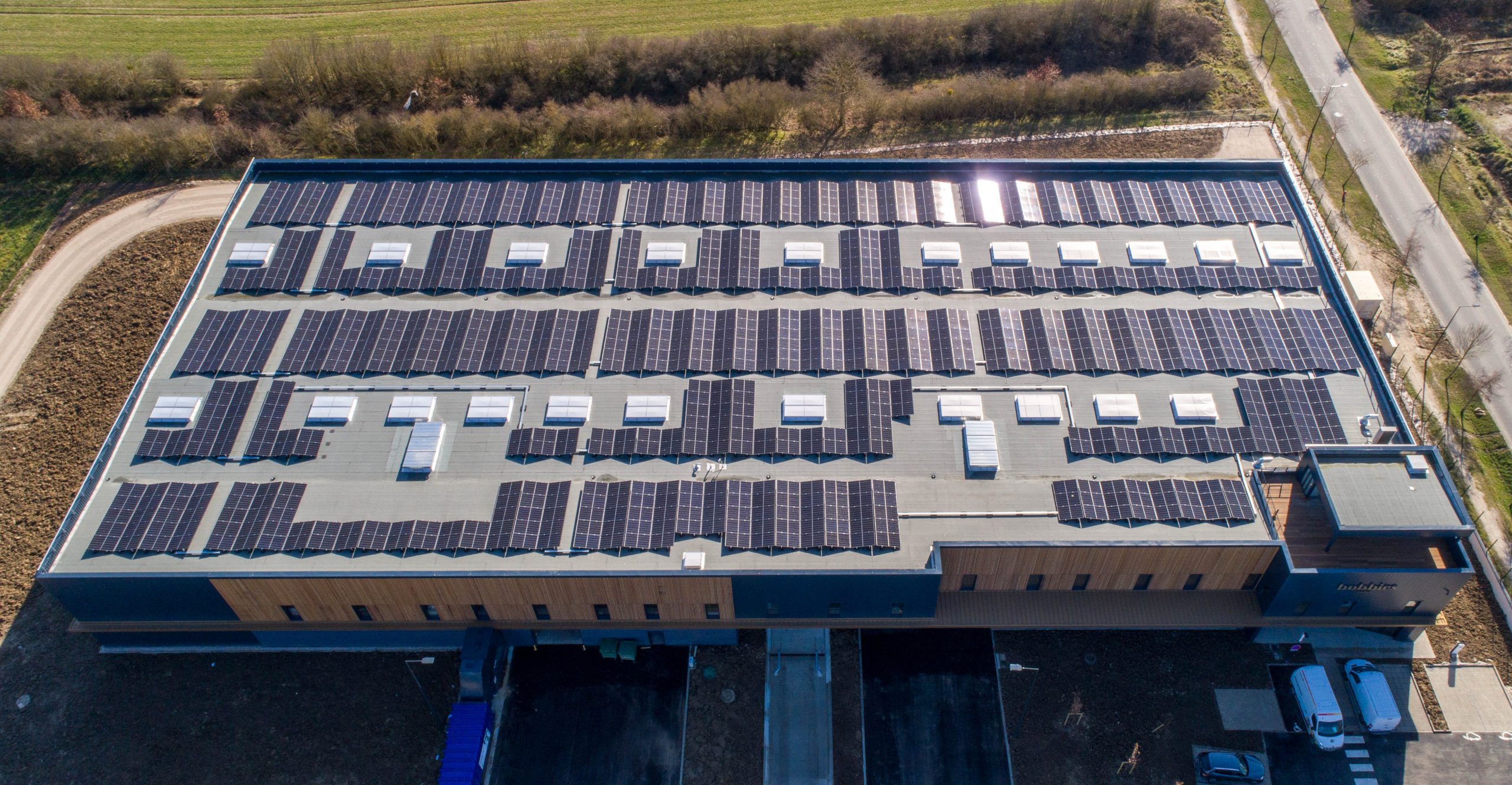
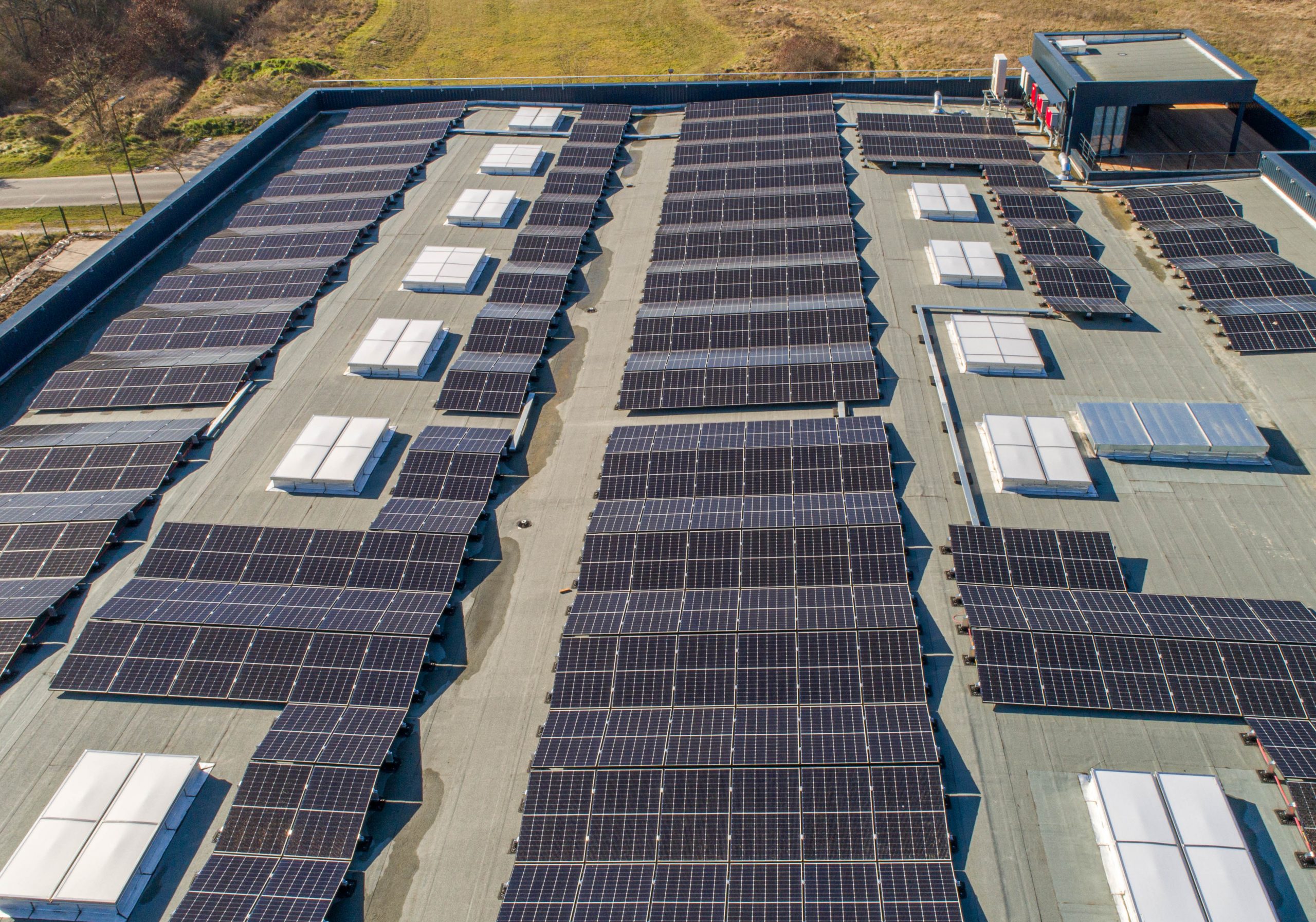
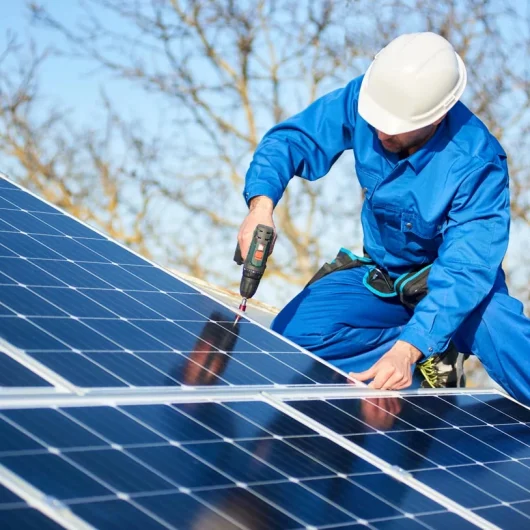
Alternatively, you can opt for a roof-mounted power plant, the most traditional solution, which is more or less appropriate depending on the condition of the roof.
In some cases, a ground-mounted power plant can be installed, although permits are often difficult to obtain.
Last but not least, the plant can be installed on the roof of a building to be constructed, whether for storage, workshop or other purposes.
To find out more about these solutions, click on the following links:
- Photovoltaic shading systems for parking lots
- Roofing rental
- Photovoltaic building
- Ground-mounted
How do you size your system?
When we talk about self-consumption, we need to keep two concepts in mind: the rate of self-production and the rate of self-consumption.
The self-generation rate is an indicator of a site’s autonomy from the power grid. More precisely, it’s the ratio between the plant’s total production and the total electricity consumption of a given site. Example: My power plant produces 1,000 MWh per year, I consume 3,000 MWh, my self-generation rate is 33%.
The self-consumption rate is the ratio between the production of the photovoltaic system consumed on site and the total production of the system. Example: I produce 1,000 MWh per year, consume 800 MWh and sell 200 MWh surplus to the grid. In this case, my self-consumption rate is 80%.
When designing a solar power plant for self-consumption, the aim is to optimize the combination of these two rates. This requires a precise study of the site’s consumption profile, which in turn enables us to correctly size the plant to be installed.
If you choose to work with Girasole Energies, we will carry out the study free of charge.
What financial assistance is available?
The self-consumption bonus paid by the French government applies to small-scale installations with a power output of less than 100 kWp. Girasole Energies’ power plants have a minimum output of 100 kWp. Consequently, they do not qualify for a direct subsidy.
This is not a problem in itself, because Girasole invests in the solar power system for you. You simply agree to purchase the electricity generated, at a competitive price, for the duration of the contract.
Self-consumption and the tertiary sector decree: what are the obligations?
The tertiary sector decree calls for a gradual reduction in the energy consumption of tertiary buildings over 1,000 m² over the coming decades.
A priori, self-consumption doesn’t reduce electricity consumption, only the price and the source.
But in reality, these regulations encourage the installation of renewable energy production systems, since they only take into account energy from the grid!
For example, if 25% of my electricity consumption is provided by solar panels on my site, my consumption under the tertiary sector decree will be 75% of what it was before the plant was installed.
Subject to the tertiary sector decree? Kill two birds with one stone and opt for self-consumption. You’ll benefit from green electricity at a competitive rate, while at the same time getting closer to your goal of reducing consumption – and all without investing!

What is an off-site Power Purchase Agreement (PPA)?
Do you have land that can accommodate a solar power plant at a distance from a site where you want to switch to self-consumption? You can do so by signing a Power Purchase Agreement (PPA) off-site.
In addition to developing, financing, building and operating a power plant tailored to your needs, Girasole takes care of the complex administrative procedures required to transport electricity from one site to another.
In this way, you can enhance the value of low-value land while supplying your main sites with green electricity that is sustainably competitive.